15

MIN READ

How to Think About the Robotics Market

Kevin McCordic
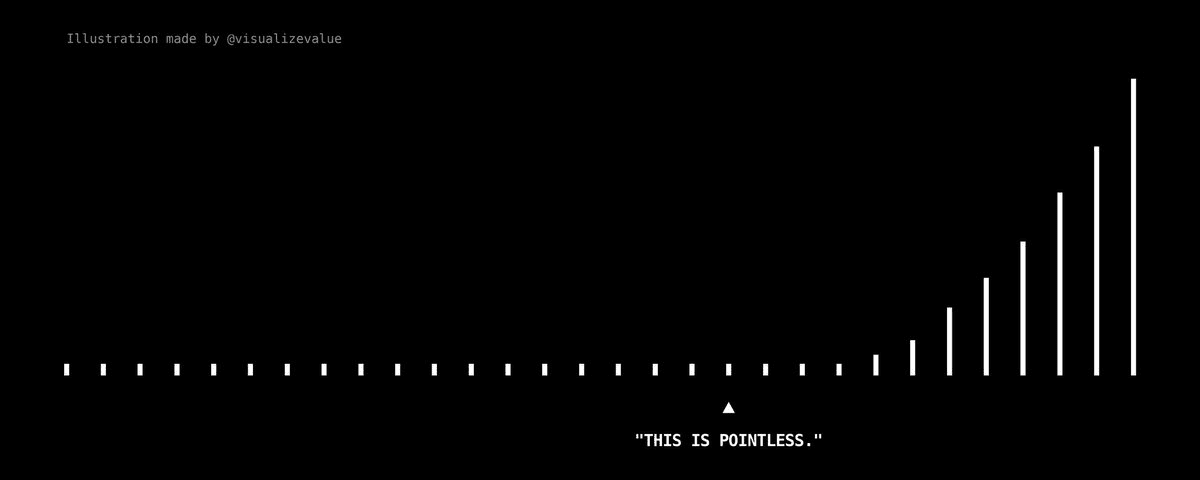
The robotics industry is at a key inflection point. Many people have little idea what is happening or how big this market could become.

I will lay out the thesis and likely outcomes so people can understand the fundamentals of what is currently happening and what is very likely to happen in the near future.

AI makes robots possible

With AI, robots now have a brain.

This is the inflection point that you need to understand.

It’s worth stating again - because of the enormous improvements in AI, intelligent robots that can do the work of humans has just now become possible. Robots that can do the work of a human has been science fiction for centuries.

This is now possible.

This is THE MOST important thing to understand. Intelligence in a machine, that can take in inputs from the complex real world, perform operations and create intelligent outputs is the key ingredient.

Source: x.com/adcock_brett

And if you zoom out from the day to day, the capabilities of AI are accelerating at an extreme rate. Improvements on a monthly basis are debated on the timeline but take the perspective on a year by year basis - the capabilities are accelerating exponentially and are likely going to continue accelerating.

This means robots will continue to get smarter, become more autonomous, and eventually be able to do the vast majority of manual labor that humans currently do. This is not far into the future. This is actually already happening today in many forms. A humanoid robot will be able to be drag and dropped into many of the current manual labor jobs in the world.

And they’ll also be much cheaper than human labor.

$1.66 Labor Costs

We are now at the point where we understand that humanoid robots will be able to be built with AI “brains” that can do the manual labor of a human.

How much will that labor cost?

Assumptions:

  • Robots work 20 hours per day (charging, maybe maintenance) and 7 days per week

  • No insurance, benefits, retraining, they don’t quit

  • $50k/robot

  • 10% annual maintenance cost + electricity

  • Robot works for 7 years

Robot cost per hour
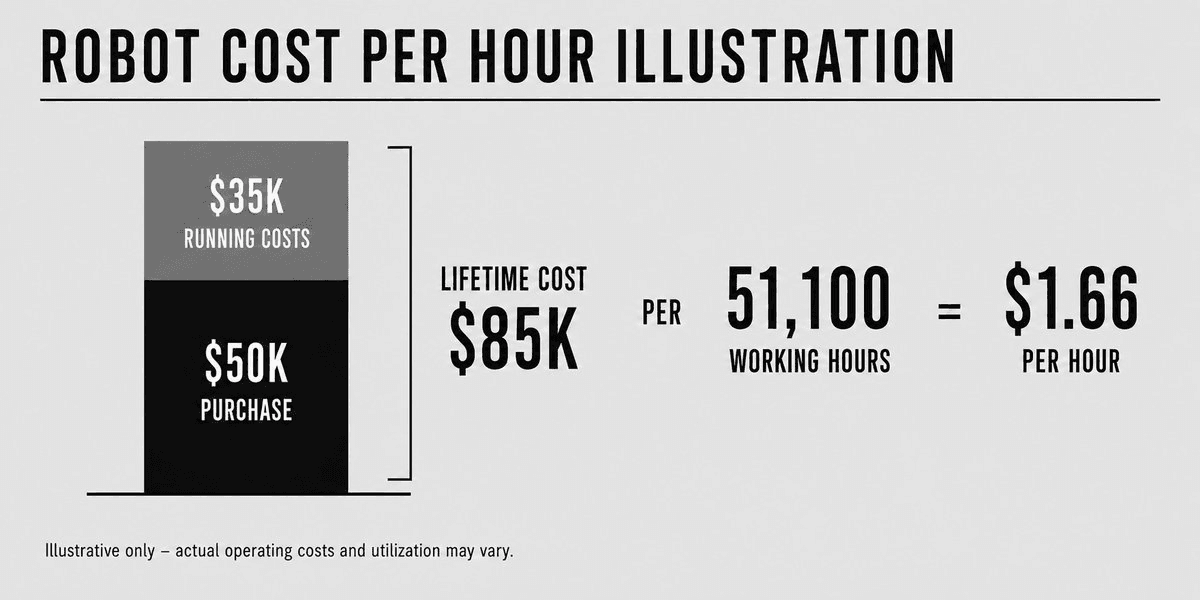
Total working hours:
- 20 hours/day × 365 days/year × 7 years
- 51,100 total hours

  1. Purchase cost:
    - $50,000

  2. Maintenance + electricity
    - $5,000/year × 7 years
    - $35,000

  3. Total lifetime cost
    - $50,000 + $35,000
    - $85,000

  4. Cost per hour
    - $85,000 ÷ 51,100 hours
    - $1.66 per hour

Total robot labor cost: approximately $1.66 per hour, including maintenance and electricity.

So maybe it is $1.66/hr. Maybe it is $3, or $5, or somewhere in between. The important takeaway is that the economics have huge room for error before they stop being compelling relative to human labor costs.

So now in our assumptions we have an intelligent robot that can work 20 hours a day every day, can be drag and dropped into the majority of manual labor jobs, and it costs under $2 per hour.

Pretty great.

Next natural question - what does the market look like for this robot?

Market Sizing (Top Down)

The total addressable market for these intelligent humanoid robots that can do the vast majority of manual labor jobs is the labor market.

What is the size of the labor market?

According to the International Labour Organization, labor accounts for approximately 52% of global GDP ¹. According to Statista, global GDP in 2025 was $118T ². This represents an implied global labor market size of roughly $60T as of 2025.
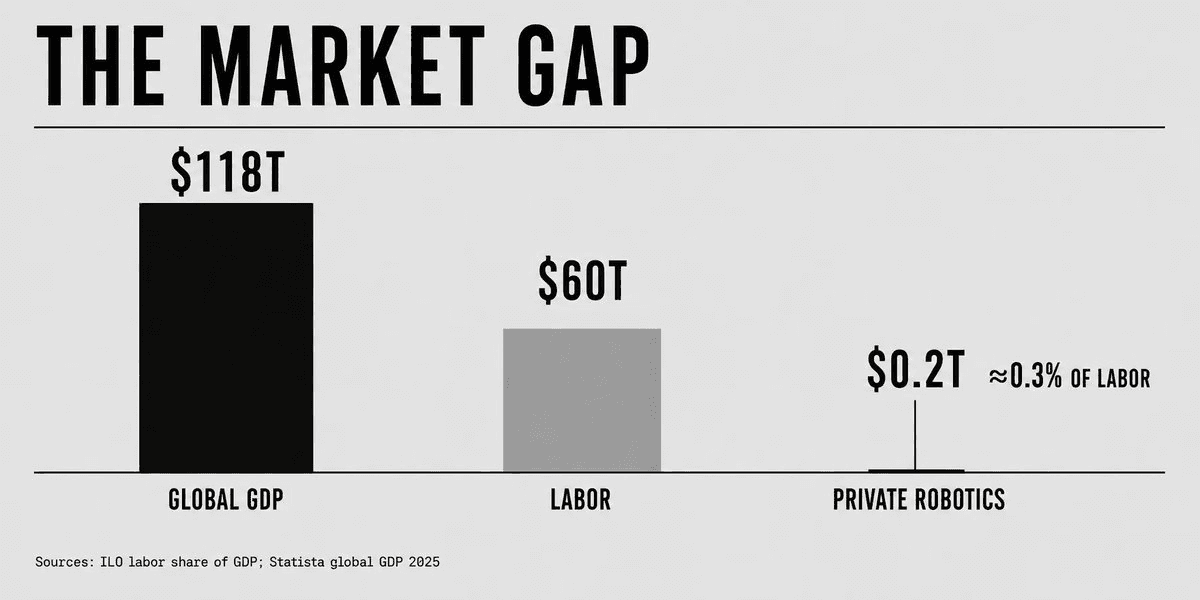
The current private robotics market by market cap is roughly $200B ³. Estimates change as it’s hard to track, but we can reasonably assume it’s between $100B - $400B ⁴.

So the TAM for these robots is roughly around $60T, and the current size of the market is roughly $200B .

That is a big discrepancy!

Source: x.com/adcock_brett

If the current private market for robotics was to reach the scale of the TAM, that would be an increase of $60T/$200B = 300x.

For comparison, that would be like Bitcoin going from $200 to $60,000.

Next natural reaction - “this seems like an insane assumption to break down the total market size of labor and then show how robots increasing to that size would be a big number.”

Very fair point to put out.

Let’s examine the market from the other angle to get a clearer picture.

Market Sizing (Bottom Up)

Walmart and Amazon each employ over 1M people who work in labor. This labor costs $20, $30, $40+ dollars an hour depending on the job. Do you think they would purchase a robot that would drop these costs to a fraction of what they’re currently paying?

I think that’s very likely.

Source: https://www.figure.ai/news/f-03-at-bmw

So then if you sell 2M robots to just these 2 companies, at $50k, that’s $100B of revenue.

Just to those 2 end buyers who can drop their costs dramatically by adopting robots.

If it turns out other companies also want to drop their labor costs and adopt robots, and you sell 10M robots, then that’s $500B of revenue.

100M robots?

$5T of revenue.

The largest companies by revenue in the world right now do under $1T in revenue each year.

And this is demand we can reasonably assume exists in the real world right now, without accounting for Jevon’s Paradox.

Needless to say, the opportunity for a humanoid robot company is quite large. The potential market demand is significant and could represent one of the larger opportunities we’ve seen across markets.

If you run the game theory, companies will very likely adopt cheap, intelligent labor to cut their costs significantly and become more profitable companies. Just basic economics.

Anyone who did not adopt robot labor while competitors did may be outcompeted, their profit margins would compress and their business may not even stay economically viable.

Selling vs Leasing

Another important callout for market-sizing is that robots could be leased instead of sold as adoption is increasing.

Everything above assumes that the robot companies are selling their robots. But what if they are leased instead?

For the next several years, the biggest constraint on the robotics market likely won’t be demand.

It will be supply.

If a company can only manufacture 1 million robots, but there is demand for 10 million robots, there likely is not a strong reason to immediately sell each robot for $50k. They could maintain ownership over the robot fleet and sell the labor it produces instead.

This is similar to GPUs today. The huge demand for compute has created business that generate recurring revenue from the same underlying hardware over its useful lifetime. Robotics companies can likely do something similar.

Take a simplified illustrative example:

  • Robot is leased for ~$50,000 per year

  • Robot has a 7-year useful life

That single robot could generate $50,000 × 7 years = $350,000 of lifetime revenue instead of a one-time $50,000 hardware sale.

Every robot produced basically represents a scarce, revenue generating asset wth years of future cash flows attached to it.

So the market sizing may not necessarily be:

Number of robots * sale price = revenue

The market may look more like:

number of robots * annual economic output * years of useful life = revenue

This potentially makes the economics of the winning robotics companies much more attractive than initially described above.

It would also change how you would calculate the cost of labor for each robot from the purchasers POV. There are a lot of variables, and for the sake of time I won’t dive into every different variation that exists here. These are probably the main 2 versions worth understanding.

Ultimately, the most valuable robotics companies may end up looking less like hardware manufacturers and more like the producers and owners of enormous fleets of on-demand productive labor.

Not a bad business model!

Quick Recap

Ok now we’ve determined:

  • Intelligent robots are possible to build, and will likely only get better moving forward

  • The estimated cost of labor over 7 years for these robots is under $2 per hour

  • The market for intelligent cheap labor is in the 10s of trillions of dollars

Surely there are bottlenecks? What else is important to know?

Scaling

Hardware is hard and manufacturing at scale is hard.

But Econ 101 teaches that supply tends to increase in response to demand. And we’ve just determined that there is an enormous amount of latent demand for these products.

A very large profit pool creates very large incentives to solve bottlenecks.

The opportunity is so large and the latent demand for cheap automated labor is so enormous that investment into the space and improvements in the tech will very likely follow. Talent, capital and technology improvements will very likely create a dynamic where these robots scale in response to demand.

Worth noting - the scaling timeline is probably the least clear out of the entire robotics thesis. However I think a few factors will make it happen sooner than most people think.

Source: https://x.com/UnitreeRobotics

Some factors:

  • Private capital: enormous amounts of private capital investment pouring in as they realize the opportunity that exists for the winners of the robotics market ⁵

  • Talent: hiring more, smarter talent, working on very high upside important problems, tends to lead to finding solutions that we currently don’t know exist

  • Robots building robots: once the robot fleet is built out enough, then the robots can start building more robots

  • National arms race: the national arms race to win the robotics market will lead to government investment and involvement which will accelerate the industry

That last point is important and worth discussing.

How does robotics matter with regard to geopolitics?

National Priority

In my opinion, it is very likely that robotics, or physical AI, becomes a large national priority in the near future.

To lay out the thesis plainly, there are huge ramifications for future GDP growth, defense, and domestic production as the global superpowers will not want a competing country’s robot in the homes and workplaces of their citizens.

It’s not an exaggeration to say that if any country gains a substantial lead in the physical AI race, then they have a very clear path to dominating the geopolitical landscape. The wealth creation and defense outcomes alone would dwarf most other factors in a country’s global standing.

This has already started.

The FCC has moved to prevent importing foreign humanoid and quadruped robots ⁶.

This may seem like a small step, but I believe it’s signaling that the US government understands the implications involved with the intelligent robotics race. And I think this is just the beginning of their involvement.

The amount of national involvement and investment will very likely increase from here on out, and the amount of announcements around their involvement will accelerate.

If/when the US government puts their weight behind this industry, the acceleration and capital going into this buildout will be multiplied. And it is my opinion that it’s only a matter of time until that happens.

The US will likely form a National Robotics Strategy which will have huge implications for the growth and buildout of the robotics industry.

Source: x.com/adcock_brett

In Summary

The robotics industry:

  • Just recently became possible with the advancements in AI

  • Is currently doing automated human work

  • Is improving rapidly

  • Can cost under $2 per hour at scale

  • Is around $200B today

  • Is going after a market that is roughly $60T

  • Has significant potential demand that could support substantial expansion of supply

  • Is already becoming a national priority

  • Is likely to become one of, if not the most important industry as it relates to geopolitics

And it’s all playing out in real time today.

References:

1: International Labour Organization, World Employment and Social Outlook: May 2025 Update: https://ilo.org/sites/default/files/2025-05/WESOUpdate_May2025_1.pdf

2: Statista, Gross domestic product (GDP) in current prices worldwide: https://statista.com/statistics/268750/global-gross-domestic-product-gdp/

3: Straits Research - Robotics Technology Market Report (Feb. 2026): https://straitsresearch.com/report/robotics-technology-market

4: The lower bound corresponds to pure-play private robotics and physical-AI companies with disclosed or reported valuations (approximately $125B as of August 2026). The upper bound additionally includes autonomy-adjacent private companies, principally Waymo (~$126B) and Anduril (~$61B, May 2026 Series H), plus a long tail of smaller companies.

5: Pitchbook - Robotics & Physical AI VC Trends (June 17, 2026): https://pitchbook.com/news/reports/q1-2026-robotics-physical-ai-vc-trends

6: FCC, Public Notice DA 26-786 (July 28, 2026): https://docs.fcc.gov/public/attachments/DA-26-786A1.pdf

Disclaimers:

RoboStrategy Advisors is an investment adviser focused on robotics, physical AI, and emerging technologies.

This article is provided for information and educational purposes only and does not constitute investment advice, a recommendation, or an offer to buy or sell any security.

Forward-looking statements and opinions are based on current expectations, estimates, projections, and assumptions and are subject to change without notice. Actual outcomes and results may differ materially from those expressed or implied.

Disclaimer

RoboStrategy, Inc. is a non-diversified, closed-end management investment company registered under the Investment Company Act of 1940, as amended. FP Strategies LLC serves as the Fund's investment adviser. An investment in RoboStrategy is speculative and involves a high degree of risk, including the possible loss of your entire investment. You should purchase shares only if you can afford a complete loss of your investment.

RoboStrategy is a recently formed fund with a limited operating history and invests in a concentrated portfolio of private and public companies in the robotics and embodied artificial intelligence sectors. Investments in private companies entail limited publicly available information, illiquidity, valuation uncertainty, and the risk that the companies may never have a liquidity event. The Fund is non-diversified, which means its performance may be more volatile than that of a diversified fund and may be materially affected by adverse developments in a single industry or issuer. The Fund may use leverage, which can magnify both gains and losses.

Closed-end funds differ from open-end funds in that they do not redeem shares at the request of investors. No shareholder has the right to require the Fund to redeem its shares. Shares of closed-end funds frequently trade at a discount to net asset value ("NAV"), and there is no assurance that an active public market for the Fund's shares will develop or be sustained. Shares may trade at a discount or premium to NAV. NAV is calculated by dividing total net assets by total shares outstanding; the market price of the Fund's shares, once listed, will be determined by supply and demand and may differ materially from NAV. The majority of the Fund's investments are in private companies for which market quotations are not readily available and are valued at fair value pursuant to procedures approved by the Fund's Board of Directors; such valuations are inherently subjective.

The Fund does not anticipate paying distributions on a regular basis or becoming a predictable distributor of dividends. The Fund will not qualify as a regulated investment company for its initial taxable year ending August 31, 2026 and will be subject to U.S. federal income tax as a C-corporation for that period; the Fund intends to elect and qualify as a regulated investment company for subsequent taxable years. Investors should consult their own tax advisors.

This website may contain forward-looking statements that are subject to risks and uncertainties; actual results may differ materially. Past performance is not indicative of future results. Performance information of FP Strategies LLC or its principals, where presented, is not the performance of RoboStrategy and may differ materially in objective, portfolio composition, leverage, fees, and market environment.

This website is provided for informational purposes only and does not constitute an offer to sell or a solicitation of an offer to buy any securities; any such offer will be made only by means of the prospectus. Investors should carefully consider the Fund's investment objective, risks, charges, and expenses before investing. The prospectus, statement of additional information, and the Fund's annual and semi-annual shareholder reports contain this and other important information about the Fund and are available here or by calling (787) 722-6881. Read the prospectus carefully before investing.

Shares of RoboStrategy are not deposits, are not guaranteed or endorsed by any bank, and are not insured by the Federal Deposit Insurance Corporation or any other government agency.

By using this website, you agree to our Terms of Use and Privacy Policy.

© 2026 RoboStrategy, Inc. All rights reserved.

© ROBOSTRATEGY 2026

Disclaimer

RoboStrategy, Inc. is a non-diversified, closed-end management investment company registered under the Investment Company Act of 1940, as amended. FP Strategies LLC serves as the Fund's investment adviser. An investment in RoboStrategy is speculative and involves a high degree of risk, including the possible loss of your entire investment. You should purchase shares only if you can afford a complete loss of your investment.

RoboStrategy is a recently formed fund with a limited operating history and invests in a concentrated portfolio of private and public companies in the robotics and embodied artificial intelligence sectors. Investments in private companies entail limited publicly available information, illiquidity, valuation uncertainty, and the risk that the companies may never have a liquidity event. The Fund is non-diversified, which means its performance may be more volatile than that of a diversified fund and may be materially affected by adverse developments in a single industry or issuer. The Fund may use leverage, which can magnify both gains and losses.

Closed-end funds differ from open-end funds in that they do not redeem shares at the request of investors. No shareholder has the right to require the Fund to redeem its shares. Shares of closed-end funds frequently trade at a discount to net asset value ("NAV"), and there is no assurance that an active public market for the Fund's shares will develop or be sustained. Shares may trade at a discount or premium to NAV. NAV is calculated by dividing total net assets by total shares outstanding; the market price of the Fund's shares, once listed, will be determined by supply and demand and may differ materially from NAV. The majority of the Fund's investments are in private companies for which market quotations are not readily available and are valued at fair value pursuant to procedures approved by the Fund's Board of Directors; such valuations are inherently subjective.

The Fund does not anticipate paying distributions on a regular basis or becoming a predictable distributor of dividends. The Fund will not qualify as a regulated investment company for its initial taxable year ending August 31, 2026 and will be subject to U.S. federal income tax as a C-corporation for that period; the Fund intends to elect and qualify as a regulated investment company for subsequent taxable years. Investors should consult their own tax advisors.

This website may contain forward-looking statements that are subject to risks and uncertainties; actual results may differ materially. Past performance is not indicative of future results. Performance information of FP Strategies LLC or its principals, where presented, is not the performance of RoboStrategy and may differ materially in objective, portfolio composition, leverage, fees, and market environment.

This website is provided for informational purposes only and does not constitute an offer to sell or a solicitation of an offer to buy any securities; any such offer will be made only by means of the prospectus. Investors should carefully consider the Fund's investment objective, risks, charges, and expenses before investing. The prospectus, statement of additional information, and the Fund's annual and semi-annual shareholder reports contain this and other important information about the Fund and are available here or by calling (787) 722-6881. Read the prospectus carefully before investing.

Shares of RoboStrategy are not deposits, are not guaranteed or endorsed by any bank, and are not insured by the Federal Deposit Insurance Corporation or any other government agency.

By using this website, you agree to our Terms of Use and Privacy Policy.

© 2026 RoboStrategy, Inc. All rights reserved.

© ROBOSTRATEGY 2026

Disclaimer

RoboStrategy, Inc. is a non-diversified, closed-end management investment company registered under the Investment Company Act of 1940, as amended. FP Strategies LLC serves as the Fund's investment adviser. An investment in RoboStrategy is speculative and involves a high degree of risk, including the possible loss of your entire investment. You should purchase shares only if you can afford a complete loss of your investment.

RoboStrategy is a recently formed fund with a limited operating history and invests in a concentrated portfolio of private and public companies in the robotics and embodied artificial intelligence sectors. Investments in private companies entail limited publicly available information, illiquidity, valuation uncertainty, and the risk that the companies may never have a liquidity event. The Fund is non-diversified, which means its performance may be more volatile than that of a diversified fund and may be materially affected by adverse developments in a single industry or issuer. The Fund may use leverage, which can magnify both gains and losses.

Closed-end funds differ from open-end funds in that they do not redeem shares at the request of investors. No shareholder has the right to require the Fund to redeem its shares. Shares of closed-end funds frequently trade at a discount to net asset value ("NAV"), and there is no assurance that an active public market for the Fund's shares will develop or be sustained. Shares may trade at a discount or premium to NAV. NAV is calculated by dividing total net assets by total shares outstanding; the market price of the Fund's shares, once listed, will be determined by supply and demand and may differ materially from NAV. The majority of the Fund's investments are in private companies for which market quotations are not readily available and are valued at fair value pursuant to procedures approved by the Fund's Board of Directors; such valuations are inherently subjective.

The Fund does not anticipate paying distributions on a regular basis or becoming a predictable distributor of dividends. The Fund will not qualify as a regulated investment company for its initial taxable year ending August 31, 2026 and will be subject to U.S. federal income tax as a C-corporation for that period; the Fund intends to elect and qualify as a regulated investment company for subsequent taxable years. Investors should consult their own tax advisors.

This website may contain forward-looking statements that are subject to risks and uncertainties; actual results may differ materially. Past performance is not indicative of future results. Performance information of FP Strategies LLC or its principals, where presented, is not the performance of RoboStrategy and may differ materially in objective, portfolio composition, leverage, fees, and market environment.

This website is provided for informational purposes only and does not constitute an offer to sell or a solicitation of an offer to buy any securities; any such offer will be made only by means of the prospectus. Investors should carefully consider the Fund's investment objective, risks, charges, and expenses before investing. The prospectus, statement of additional information, and the Fund's annual and semi-annual shareholder reports contain this and other important information about the Fund and are available here or by calling (787) 722-6881. Read the prospectus carefully before investing.

Shares of RoboStrategy are not deposits, are not guaranteed or endorsed by any bank, and are not insured by the Federal Deposit Insurance Corporation or any other government agency.

By using this website, you agree to our Terms of Use and Privacy Policy.

© 2026 RoboStrategy, Inc. All rights reserved.

© ROBOSTRATEGY 2026

Disclaimer

RoboStrategy, Inc. is a non-diversified, closed-end management investment company registered under the Investment Company Act of 1940, as amended. FP Strategies LLC serves as the Fund's investment adviser. An investment in RoboStrategy is speculative and involves a high degree of risk, including the possible loss of your entire investment. You should purchase shares only if you can afford a complete loss of your investment.

RoboStrategy is a recently formed fund with a limited operating history and invests in a concentrated portfolio of private and public companies in the robotics and embodied artificial intelligence sectors. Investments in private companies entail limited publicly available information, illiquidity, valuation uncertainty, and the risk that the companies may never have a liquidity event. The Fund is non-diversified, which means its performance may be more volatile than that of a diversified fund and may be materially affected by adverse developments in a single industry or issuer. The Fund may use leverage, which can magnify both gains and losses.

Closed-end funds differ from open-end funds in that they do not redeem shares at the request of investors. No shareholder has the right to require the Fund to redeem its shares. Shares of closed-end funds frequently trade at a discount to net asset value ("NAV"), and there is no assurance that an active public market for the Fund's shares will develop or be sustained. Shares may trade at a discount or premium to NAV. NAV is calculated by dividing total net assets by total shares outstanding; the market price of the Fund's shares, once listed, will be determined by supply and demand and may differ materially from NAV. The majority of the Fund's investments are in private companies for which market quotations are not readily available and are valued at fair value pursuant to procedures approved by the Fund's Board of Directors; such valuations are inherently subjective.

The Fund does not anticipate paying distributions on a regular basis or becoming a predictable distributor of dividends. The Fund will not qualify as a regulated investment company for its initial taxable year ending August 31, 2026 and will be subject to U.S. federal income tax as a C-corporation for that period; the Fund intends to elect and qualify as a regulated investment company for subsequent taxable years. Investors should consult their own tax advisors.

This website may contain forward-looking statements that are subject to risks and uncertainties; actual results may differ materially. Past performance is not indicative of future results. Performance information of FP Strategies LLC or its principals, where presented, is not the performance of RoboStrategy and may differ materially in objective, portfolio composition, leverage, fees, and market environment.

This website is provided for informational purposes only and does not constitute an offer to sell or a solicitation of an offer to buy any securities; any such offer will be made only by means of the prospectus. Investors should carefully consider the Fund's investment objective, risks, charges, and expenses before investing. The prospectus, statement of additional information, and the Fund's annual and semi-annual shareholder reports contain this and other important information about the Fund and are available here or by calling (787) 722-6881. Read the prospectus carefully before investing.

Shares of RoboStrategy are not deposits, are not guaranteed or endorsed by any bank, and are not insured by the Federal Deposit Insurance Corporation or any other government agency.

By using this website, you agree to our Terms of Use and Privacy Policy.

© 2026 RoboStrategy, Inc. All rights reserved.

© ROBOSTRATEGY 2026