20
MIN READ
What Makes a Robotics Business Economically Viable
Jack Pearson
Humanoids or specialists: who wins?
It’s the question every panel, pitch deck, and timeline argues about: general or special-purpose machines. Humanoids vs everything else.
Pick a side. Place your bet on who takes the market. There are strong voices on both sides, but in my opinion, to answer this, you need to understand what makes robots economically valuable.

The joke in the industry is that a robot stops being a robot the moment it works. It just earns a name, like a dishwasher, a car, a washing machine.
Strip away the mystique, and a robot is a tool for delivering a value at the right cost. That reduces every automation decision to a single relationship.
Understand this framework, and you understand how to build a successful robotics business.
This piece comes in two halves: first, the framework itself, then a few ideas it unlocks.
Part I — The framework
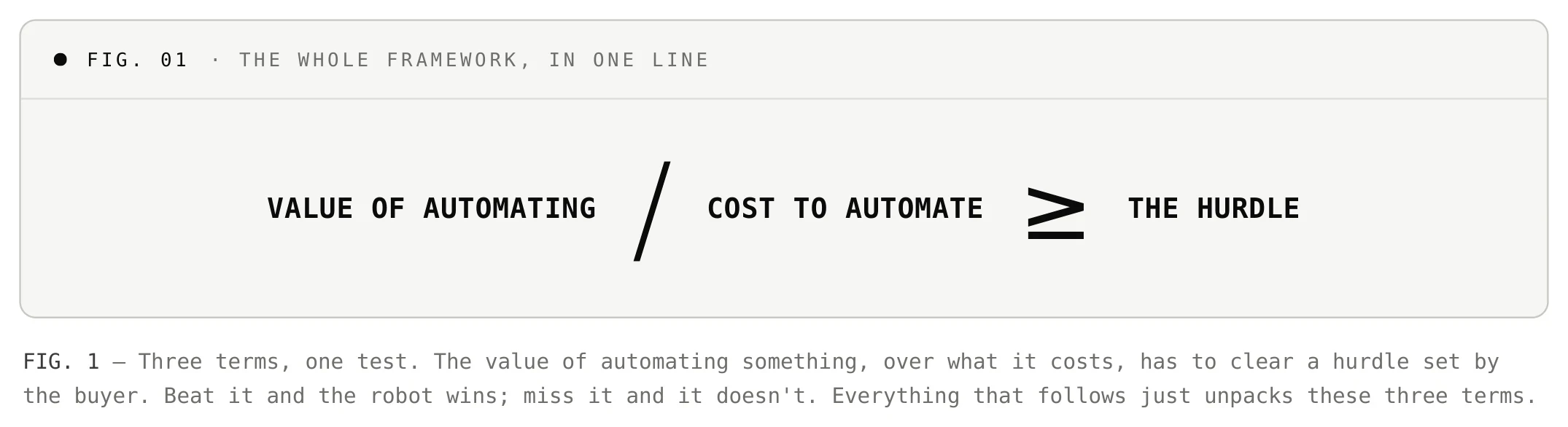
Three terms. The value of automating something, over what it costs to automate it, has to clear a hurdle.
Beat the hurdle and the robot wins; miss it and it doesn’t.
It sounds obvious, and it is, yet most operators, buyers, and investors don’t actually decide this way.
Pillar 1 · Value — the numerator: what’s the prize?
The instinct is to equate the value of automation with labour cost avoided. Talk to a buyer, and they will nod along to every other benefit, then anchor the decision on headcount. This leaves a lot of value on the table.
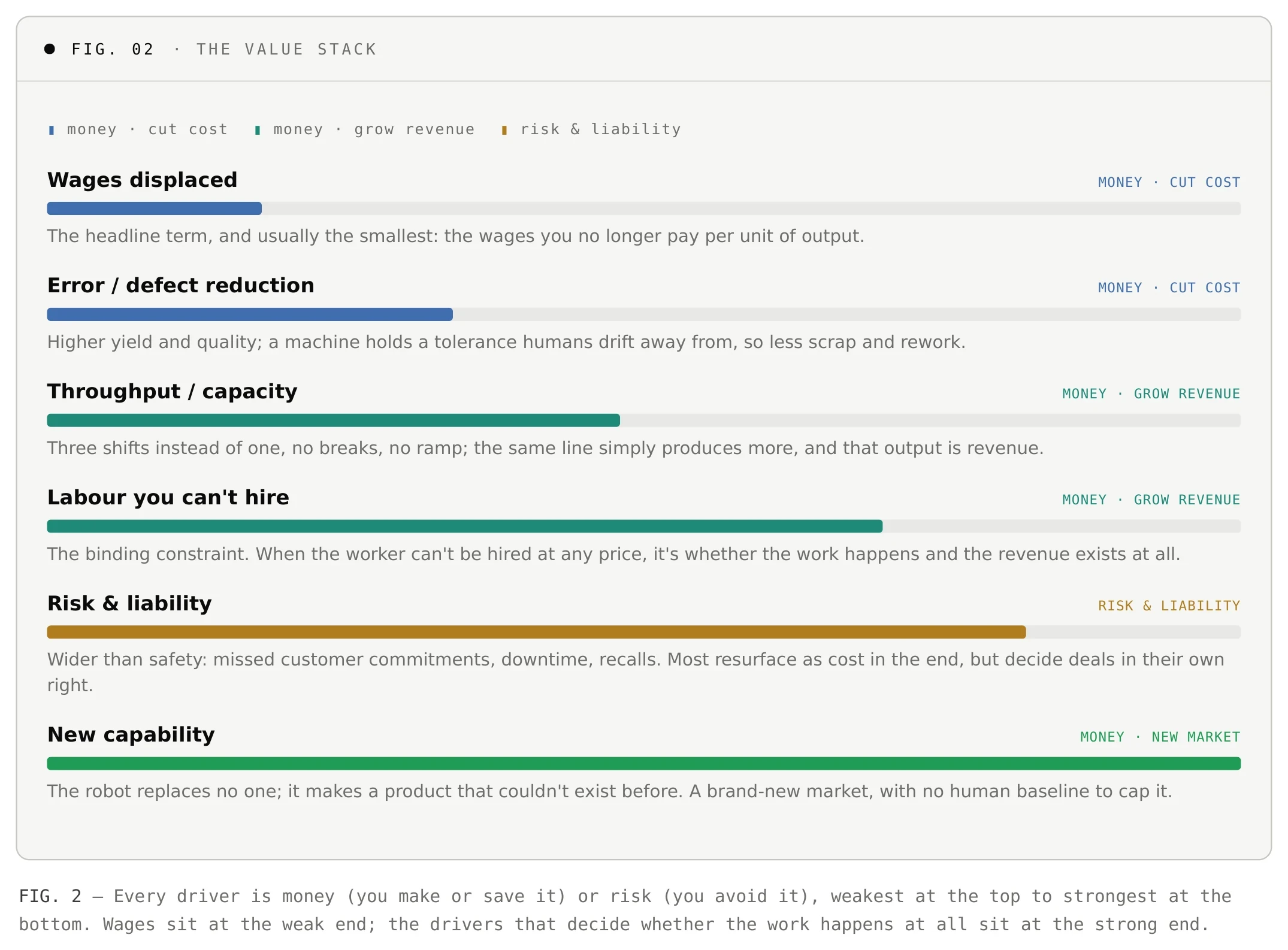
To see the whole prize, start one level up.
Value reduces to money or risk. Either it makes money, by cutting a cost or growing revenue, or it takes away risk: the liability, the safety exposure, the thing that can go badly wrong. In the end, risk usually boils down to money too; it is business, after all.
The real trick in robotics is not to get stuck as a pure labour-arbitrage play, but to climb this stack toward the drivers that are far harder to compete away.
Mental model — the binding constraint. In any system, one thing is the rate limiting everything else. Relieve that constraint and the whole system moves; improve anything else and nothing happens. The art is finding which factor is actually binding, because effort spent anywhere else is wasted.
Labour availability is often the binding constraint. For a lot of physical work, labour is the binding constraint. When it is, the comparison everyone reaches for, “human cost vs. robot cost,” quietly breaks, because there is no human to compare against. You cannot hire the welder, the machinist, the night-shift picker at any wage. So the robot isn’t saving you a salary; it’s the difference between the work happening and not happening, between booking the revenue and losing it. Flexibility and capacity ride the same logic: a line you can run unattended, around the clock, or surge on demand is worth the revenue that extra production unlocks. It still resolves to money; it’s just revenue you couldn’t otherwise capture, not cost you trimmed.
New capability — value with no ceiling. Some of the most valuable robots don’t replace a person. 5-axis 3D printing, MEMS-scale assembly, fabrication in microgravity: none of these do an existing job more cheaply. They make a product, or a whole market, that did not previously exist. Because no labour is being displaced, counting wages tells you nothing at all. The value is an entirely new addressable market, and since there’s no human baseline to measure against, in principle, it has no ceiling.
Substitution vs. new capability. Substitution, doing existing work more cheaply, has guaranteed demand: the work is already being bought. But its value commoditises, because as the technology gets cheaper, competitors pile in and the margin erodes. New capability has no initial commoditisation risk, since you’re defining a category rather than fighting for a slice of one, but the demand has to be created from nothing. The graveyard of “amazing technology, no buyer” is full. There’s no right answer here; just make sure you pick your poison consciously.
Pillar 2 · Cost — the denominator: what does it really take?
Cost to automate is the all-in cost of making the thing actually work in the field, not the sticker price of the machine.

Build it once (fixed: paid before a unit ships, amortised across everything you ever sell)
Development: the AI/software stack, training data, and simulation. The deep technical build, spent long before a single unit ships.
Certification: FDA, AS9100, ITAR. Slow and expensive on the way in, a moat once you hold it.
Org overhead: the people and infrastructure you fund between deals. Management, G&A, facilities, and the standing sales and engineering org. Doesn’t amortise cleanly per unit or per customer; it’s the cost of keeping the lights on.
Land it (variable per customer: paid again for every new account you win)
Cost to land: the sales cycle, POCs, and pilots that win the contract. The most underweighted line in robotics. Customer acquisition is expensive and can stay underwater for long periods; a model that assumes the deal is already won has skipped the largest line.
Integration: fitting the system to that customer’s site, process, and workflow once the contract is signed.
Run it (variable per unit: recurring for the life of every deployed machine)
Unit hardware (BOM): the build cost of the machine itself. Per-unit, scales with volume, and the one line a “not the sticker price” framing quietly drops. The largest cost in many systems.
Op-cost: what each unit consumes just by running. Energy, compressed air, consumables, end-effector and tooling wear, and increasingly the inference and compute load of AI-heavy systems. A recurring per-unit drag, not a one-time support line.
Maintenance: keeping it running. Service, spares, repairs, edge-case handling, and ongoing human oversight.
Downtime & failure: the big one that kills deals. When the line stops, to install or because the robot failed, the customer eats lost production, which in a real plant can run to hundreds of thousands of dollars an hour and into the millions in the largest plants. And failure scales with the stakes: a dropped box at one end, a dead patient at the other. This is where the Black Swans lie.
Expensive is not the same as unaffordable. These two words get used as if they’re the same. Expensive is about the robot: it costs a lot of resources to build and run, and you fix that with engineering, as better design, scale, and cheaper hardware drive the cost down.
Unaffordable is about the buyer: even at a fair price, they can’t fund the cheque or can’t justify it on their clock, and you fix that with financing, not engineering. Confuse the two and you’ll burn years trying to engineer your way out of a financing problem, or discount your way out of an engineering one. Which brings us to the hurdle.
Pillar 3 · The hurdle — the bar: clearing value-over-cost isn’t enough
A value-to-cost ratio of 1 is break-even: the robot just pays for itself, which is no reason to buy it. You need the ratio above 1; how far above is the hurdle.
That bar is different for every buyer, which is why treating it as a single textbook cost of capital is the most common mistake.
Two buyers facing the identical opportunity (the same labour shortage, the same defect risk, the same machine at the same price) will demand wildly different returns before they move. The hurdle isn’t set by how badly they need the robot. It’s set by the capital behind the decision, and that resolves into two independent dials.
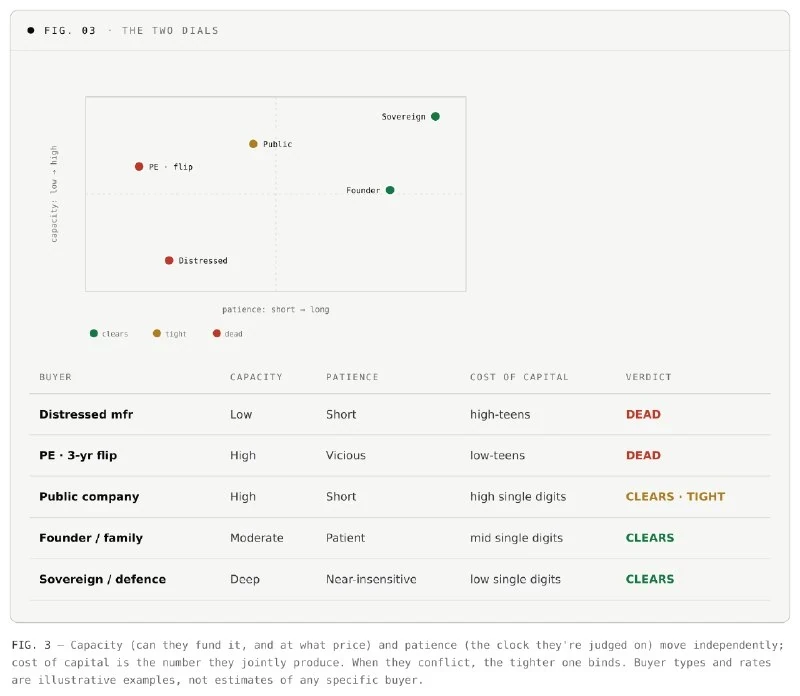
Dial one · the gate — Capacity: can they pay, and at what price? This is the buyer’s ability to source the capital at all. A strong balance sheet, access to cheap credit, and free cash flow mean the cheque can be written without strain. A thin balance sheet, high leverage, or no access to credit means a positive-ROI deal still dies, not because the maths is wrong, but because the buyer can’t fund it.
Capacity is also the dial you can engineer against, which makes it the more actionable of the two. Robotics-as-a-service is not a pricing nicety; it’s a financial instrument aimed squarely here. It converts a capex hurdle the buyer can’t clear into an opex line they can, manufacturing capacity where the balance sheet didn’t provide it.
Dial two · the clock — Patience: over what horizon is it judged? This is the time horizon the decision-maker is measured against, and it is almost never the economic life of the asset. The person signing off isn’t running a clean NPV across the machine’s ten-year life. They’re optimising the clock they’re judged on: private equity on a three-year flip is vicious (anything past the exit is the next owner’s problem); a public company on quarterly EPS is short; a founder or family business is patient enough to underwrite a ten-year payback; a government, defence, or mandate buyer is near-insensitive, its clock set by the mission, not the return. Patience is the dial that diverges most from textbook rationality, which is exactly why people miss it.
Cost of capital is the output, not a third dial. Cost of capital isn’t a separate determinant; it’s the number these two dials produce. A weak balance sheet doesn’t just gate the deal, it raises the price of the money, because a riskier borrower pays more. An impatient owner discounts the future harder. Capacity and patience are the inputs; cost of capital is what they jointly manifest as.
The screen. So the screen is two questions, not one ROI number: can they fund it? (capacity) and on what clock are they judged? (patience). A great ratio against a vicious hurdle is still a dead deal.
It was net present value all along
As promised up top, here’s the full formula. And since the point of all this is to be useful to non-finance people too, let’s build it from scratch.

First, what NPV actually is. Money has a time value: a dollar in your hand today is worth more than a dollar a year from now. You could invest today’s dollar and have more next year; you’d rather not wait; and the future dollar might never arrive at all. So when you weigh a big spend now against benefits spread over years, you can’t just add the benefits up; the later ones are worth less.
Net present value fixes that. You take each future year’s cash, discount it back into today’s money, add up the whole stream, and subtract what you paid up front.
Positive total: the project creates value, do it.
Negative: it destroys value, walk.
It’s the closest thing finance has to a universal yes/no, which is why almost every serious capital decision (robot or not) comes down to it.
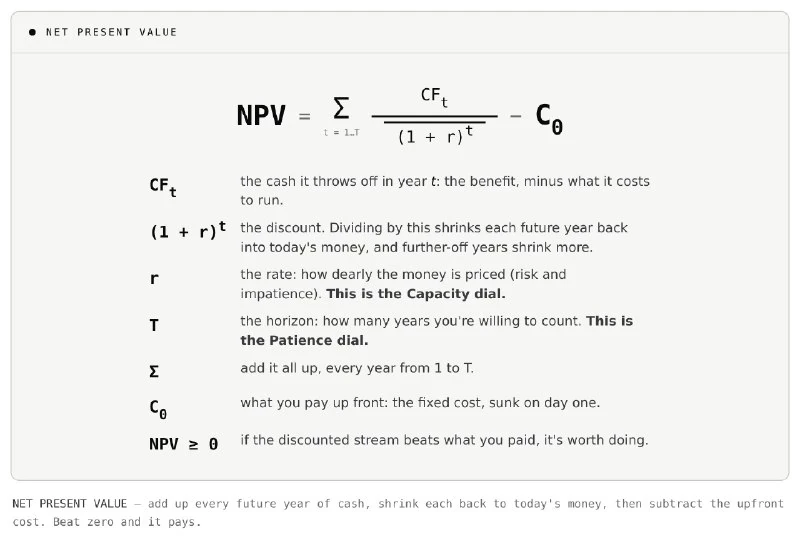
This boils down to: the cash it earns (CF), the discount that prices waiting and risk (r, applied over T years), and the capital you sink (C₀) …which is exactly our framework.
And here’s the part that matters for robotics: two of those, r and T, aren’t properties of the robot at all. They belong to the buyer. That’s the whole reason the same machine clears for one customer and dies for another. They are the two dials from Pillar 3.
Part II — Putting it to work
Everything that follows is a way of pointing that same equation at a real opportunity.
01 · The lever — AI’s primary lever is cost
Of everything acting on this framework today, AI is the biggest force, and it pulls one lever the hardest: cost.
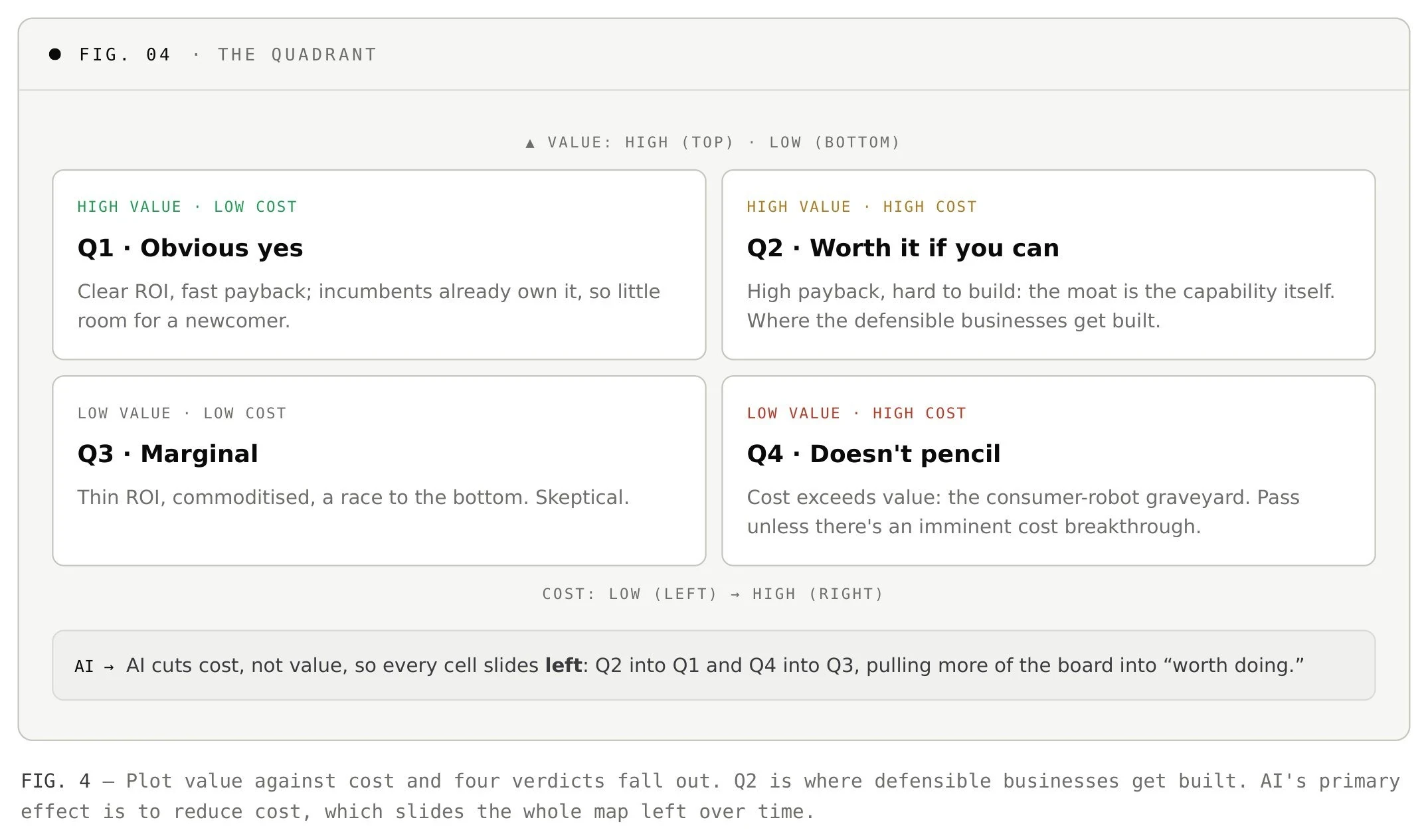
AI’s primary effect is to reduce the cost to automate; it does not move things rightward into higher value.
Foundation models cut per-task development; sim-to-real cuts physical training; better perception absorbs variability without custom engineering; transfer learning carries development cost from one task to the next. But AI moves the value side far more slowly: welder scarcity and wages don’t fall because a model improved.
The one exception: when AI enables yield or quality beyond human capability, it creates value that didn’t previously exist. A real effect, but smaller than the cost reduction.
This is physical AI’s real economic effect: it doesn’t make robots more valuable, it makes them cheaper, and every drop in cost drags more applications across the line into “worth doing.”
02 · A proxy to retire — Volume was a good proxy, but it isn’t the test
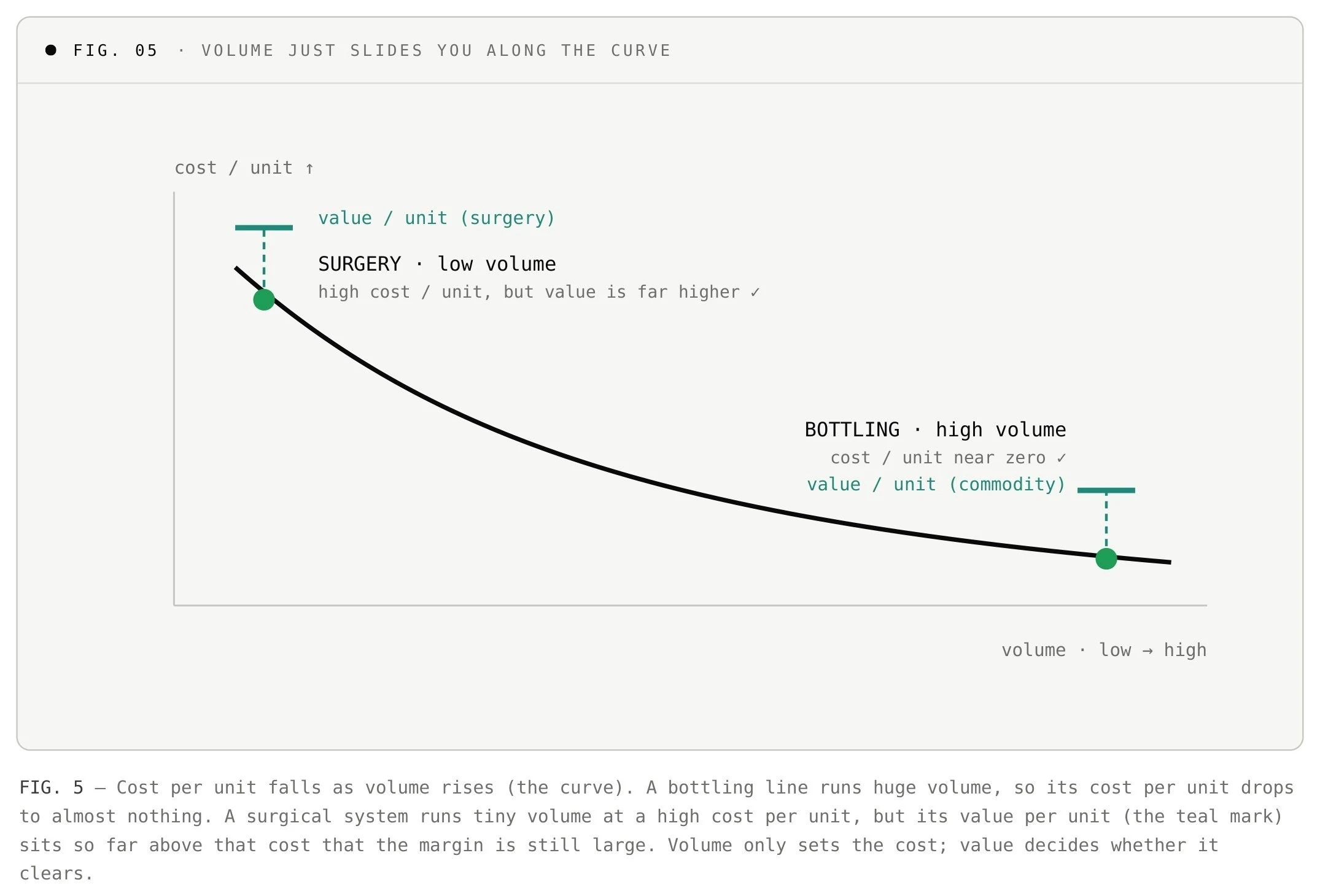
Here’s the instinct almost everyone carries: high volume means automatable, low volume means not. It comes from real history, and it’s easiest to see as three tiers. A dedicated bottling line is pure fixed automation: one job, millions of units a year, and it only pays off at that scale. A step down, a 6-axis robot arm isn’t purpose-built, but the tooling and programming to deploy it still only pencil at tens to hundreds of thousands of units. Below that, automation simply wasn’t feasible. In that world, volume genuinely was a decent proxy for “can this be automated.” That is why the most automated industries are the highest volume: automotive, pharma, and food and beverage.
Two things break the proxy. First, AI is dragging that cost curve down (exactly as we just saw), so the volume at which automation pencils keeps falling. Second, and more important: the number that matters is how many times the task runs, against how much each run is worth, not how many machines you sell. Push the value per run high enough and the maths works at a tiny count. A surgical system performs a few thousand procedures over its life, not the millions a bottling line runs, yet each one is worth so much (surgeon-hours, liability, outcomes) that it pays the machine back many times over. The same holds in aerospace and defence, where a cell might lay up a few hundred wing spars or weld a handful of engine assemblies a year, each worth a fortune. Run the real framework — value over cost against the hurdle — and you stop needing the proxy at all.
03 · Complexity — Complexity drives both value and cost
Value and cost look like two separate levers. Look at how they relate, though, and a single hidden variable moves both at once: complexity. More complexity raises cost: more to develop, more sensors and degrees of freedom, harder integration, longer deployment, and eventually a frontier no amount of money can cross. But the very same complexity raises value: the labour displaced is scarcer and pricier, human error is higher so there’s more yield to recover, and fewer people can do the work at all. So the question is never “is this complex?” It’s which side does complexity grow faster, value or cost?
Start with inputs and outputs. To answer that for a real task, separate two things. The world supplies the inputs (how hard the task is). The robot must supply the outputs (the capability the task demands). Inputs tell you how hard the market is; outputs tell you how good the company has to be; and the whole question is the gap between what’s required and what can be delivered today.
Inputs · the task: process complexity · part variability · environmental variability · regulatory burden · failure cost · tacit, learned-by-feel knowledge.
Outputs · the robot: dexterity · precision · sensing · speed · reliability · adaptability.
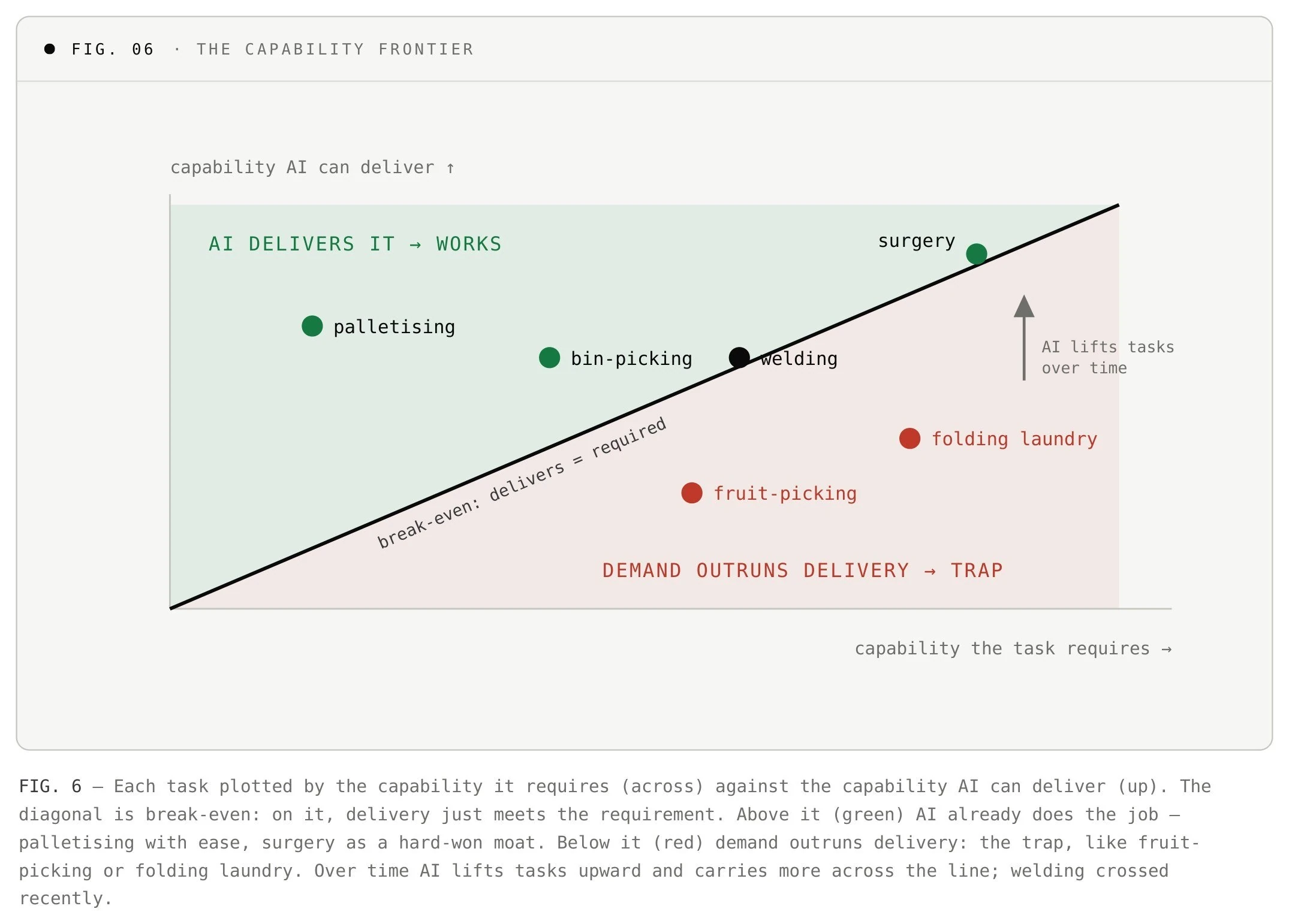
Surgery is the proof of the double edge. On a naïve “insanely hard, tiny volumes” view it looks like a terrible automation target. On a value-over-cost view it flips into one of the best businesses in robotics: the value per unit is so high it swamps the cost. Never read complexity as just a cost; the edge that matters is the one that outruns the other.
04 · Both camps win — General vs. special purpose
Now the opening question pays off. Special and general purpose aren’t rival philosophies. They are two routes to the same square — Q1 — and each is the right route for a different kind of task. The deciding question is the framework’s question: does this task clear the hurdle on its own, or only as part of a bundle?
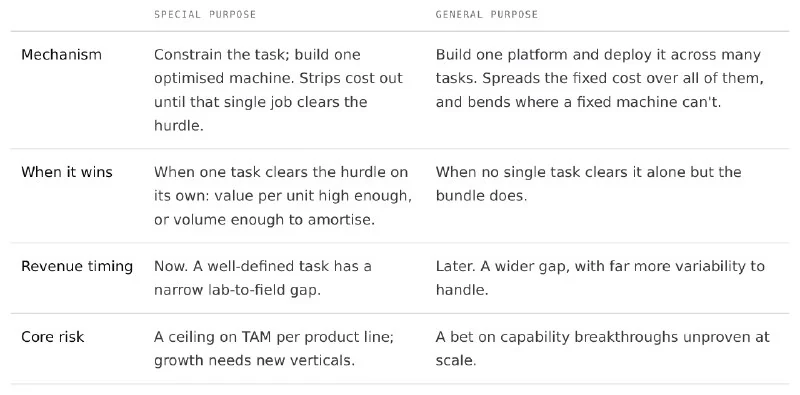
Sometimes the deciding factor isn’t the economics at all. If the work is too varied, if the task mix keeps changing, or if a fixed machine simply won’t fit the space it has to work in, you need a general, adaptable platform whatever the volume. Special purpose works the cost axis directly: narrow the task, build it cheap, win now. General purpose spreads fixed cost across many jobs, and bends where a fixed machine can’t.
So yeah its a cop out - the real world is nuanced and I believe that general-purpose and special-purpose robots will strongly pass the hurdle in the future.
05 · Sequencing — Deep-then-wide vs. wide-then-deep
The best operators are converging on deep-first: win a specific high-value task now (a special-purpose entry), accumulate data, revenue, and operational credibility, then expand outward, funded by real margin rather than only outside capital. The compounding is the whole point: revenue funds development, deployment data from real operations improves the model, customer relationships create lock-in and expansion, and certification in one domain seeds credibility in the next.
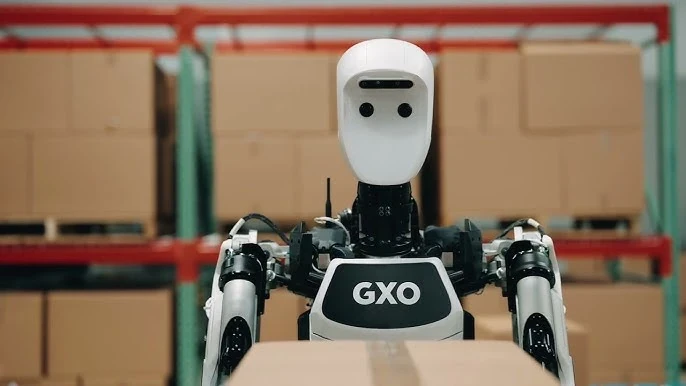
The canonical case is a general-purpose hardware form factor with a narrow, special-purpose go-to-market: a humanoid body, say, deployed first on a single high-volume task. That’s deep-first wearing general-purpose clothing: the body is a strategic option on future breadth, not the current product. The opposite bet, wide-first (spreading across many tasks from day one), only works if a generalist model beats specialists at each individual task, which today it does not. The lab-to-field gap (roughly 95% in the lab, 80% in the field) applies to every task independently, so wide-first compounds that risk across the entire task set at once. Deep-first generates returns while the technology matures; wide-first burns capital until it does.
In closing, all models are wrong; some are useful
A framework is a model, and every model is wrong, this one included. It won’t tell you who wins. What it gives you instead is a scalpel: a way to quantify what usually goes unquantified, and to cut past the mystique of robotics to the one thing that matters: a machine that has to deliver a net value, nothing more.
A robot is a tool for ROI, and to make a robotics business viable, you only have three levers, with a million ways to combine them:
Raise the value — climb the stack, past wage savings toward capacity, risk, and new capability the world can’t get any other way.
Cut the cost — engineer it down, and let AI keep dragging the cost curve lower so more applications cross the line.
Find a low hurdle — sell to capital that can fund it and is patient enough to wait, or re-engineer the deal until it can.
By Jack Pearson · Investment Principal, RoboStrategy Advisors
Important disclosure
RoboStrategy Advisors is an investment adviser focused on robotics, physical AI, and emerging technologies. This discussion is provided for information and educational purposes only and does not constitute investment advice, a recommendation, or an offer to buy or sell any security. Any opinions expressed are those of the speaker as of the recording date and are subject to change. Forward-looking statements and opinions are based on current expectations, estimates, projections, and assumptions and are subject to change without notice. Actual outcomes and results may differ materially from those expressed or implied. Any references to prior investment experience, portfolio companies, or investment outcomes relate to activities conducted outside of RoboStrategy and are provided solely for background and informational purposes. Any referenced gains, returns, or investment outcomes may be unrealized and are not indicative of future results. Investing involves risk, including possible loss of principal. References to companies, technologies, or investments are illustrative only and should not be interpreted as investment recommendations.
© 2026 RoboStrategy Advisors. For informational purposes only.