Published on
Thursday, August 20, 2026
Unitree's IPO, explained.
One of the more established humanoid robotics companies is about to go public, and their cap table is a who's who of Chinese capital.
Unitree is a rare case: they have built a line of humanoids that you can buy direct at an affordable price. As a result, they have become one of the most ubiquitous robotics brands with 5,215 sold last year.
Unitree's value proposition is to sell robots at low prices through direct and distributor channels. They are not the highest specification machines in the market, and they are not certified for challenging environments, but they are affordable and performant enough for research and light tasks.
In our latest Unitree IPO memo, we examine the company's business, technology, competitive position, and upcoming public listing.

Unitree humanoids on a production line.
A humanoid has roughly 20 to 40 actuators, which typically account for 40% to 60% of a humanoid's bill of material cost.
Unitree bucked trends by leaning on in-house quasi-direct drive (QDD), an actuator made from a motor paired with a low-ratio planetary gearbox, whereas the industry favors the strain wave gearbox.
Roughly 70% of the humanoids Unitree shipped in 2025 went to universities and research institutions. Industrial customers are only 9% of humanoid revenue.
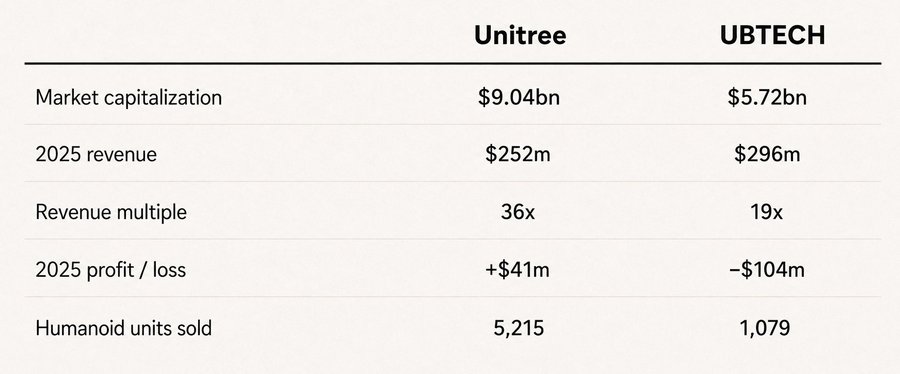
Unitree and UBTech compared. RoboStrategy analysis. See FN1.
Unitree has three key product lines.
Quadrupeds are the mature business. Nine years old, 33,294 sold in the last three years alone, 41.62% of main business revenue in 2025 at a 56.72% gross margin.
Humanoids are the growth engine and the headline generator. From under 10 units in 2023 to 412 in 2024 to 5,215 in 2025. Revenue share went from 1.88% to 51.78%, or US$129m, in two years.
Components are strategic rather than material, they include motors and other miscellaneous items. The revenue share has fallen to 6.19% from 17.66% in 2022 as the robot lines have grown faster. This segment matters more than its size because it proves the vertical integration is real enough to sell to third parties.
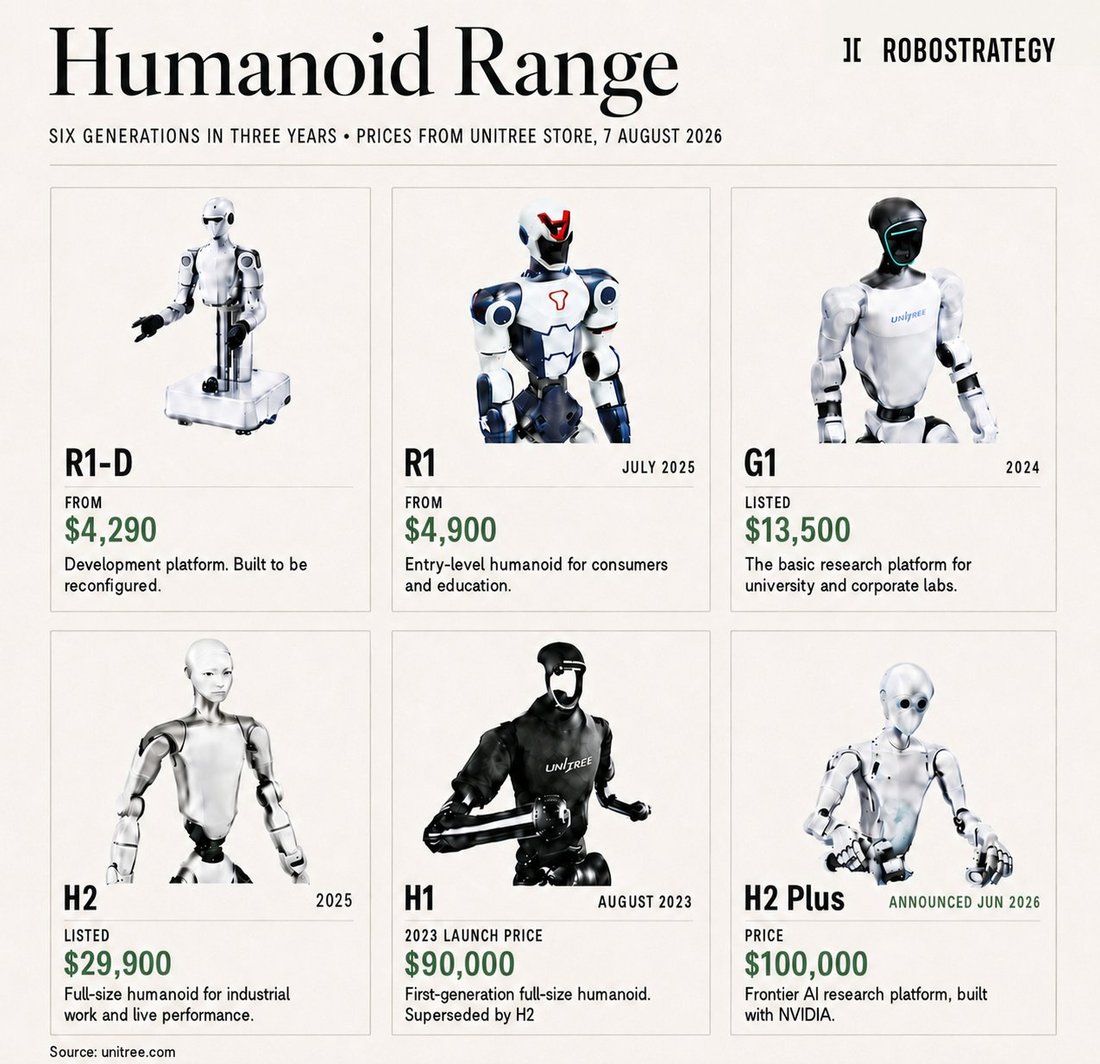
Humanoid range and pricing. RoboStrategy analysis. See FN5.
Unitree's position is strong, but the Chinese humanoid sector went from a handful of credible players to a crowd in under two years. Many of them have been inspired by Unitree and are running with its playbook.
More than 400 Chinese humanoid models were in market by the first half of 2026, over half the global total and Chinese robotics firms raised $5.6bn in under five months.

Humanoid robotics companies in China.
We believe the answers to these four questions will decide Unitree's success.
Do they need the US market?
Can they build the brain?
Can they win the industrial market?
Can they beat their competition?
Read our in-depth answers to all of the above, including bullish and bearish scenarios, in our Unitree report here.